 1Q: Tell us a little about the origins of SOLACE, from concept to financing.
SOLACE was actually only supposed to be a short from the beginning. Two films; Quentin Tarantino’s Inglorious Basterds and Joe Carnahan’s Narc mainly influenced me. I loved the feel of the opening scene of Inglorious Basterds between the Nazi and farmer and the third act in Joe Carnahan’s Narc where two cops interrogate a pair of suspects tied up in a chop shop. Both scenes take place in one location, were dialog driven, and lasted between twenty to thirty minutes. This was the route I was choosing to take because of my limited resources. I was keeping it simple.
That’s the moment where actors Russell Comegys and Dixie Light came to mind. I’d met them through my Producer, Jyn Hall, as they had auditioned for me previously. They were great, just not the right for that project so I told them I’d give them a call if I had something that was a better fit. And that’s what I did… almost nine months later. Luckily, they remembered me, (so they say) and took my call. I explained my SOLACE idea and surprisingly they were interested in seeing a script, which I didn’t have at that point. I had an abandoned warehouse in mind for the location and just needed to write a story that gave them a reason to be there which was easier said than done. It’s difficult enough to pull off a five-minute scene with just characters talking and not bore the audience to death, let alone a compelling twenty to thirty-minutes that sustained tension and suspense throughout.
I sent them the first draft of the warehouse scene and they both loved it. My only issue at that point was that I felt like there was more of the story I wanted to see. I went back to the drawing board and added two more scenes that tied everything together and just like that, my short had become a feature.
Financing was tricky as initially, I only planned to shoot a short. Growing it from one scene to three tripled my budget. I accepted money from friends, family and also used finances from my personal savings and credit cards. I had just began taking class as at Savannah College of Art and Design as a Film/Television major so I ran the student discount plea into the ground.
2Q: Cinequest is proud to host the World Premiere of SOLACE. Explain to the audience how you feel about bringing this film before audiences for the first time, and what do you think their reaction will be to your film?
I think the audience will enjoy their SOLACE experience giving them an equal share of laughs and thrills.
3Q: What was your best and/or worst experience while making SOLACE?
 The worst experience had to be the first day of shooting. I’d prepped the first scene for almost four months before we actually shot it. During that time I had ran across a lot of people who were drawn to the project and wanted to help out in any way possible. Eventually, the crew grew to a number that was more than we needed for such a small shoot. This made the first day big and slow as opposed to small and fast. It’s daunting when you have twenty-five pages of dialog to shoot in three days and you only get through three the first day. I think I was the only one who thought we’d finish on schedule and budget, and we did. We were able to do it by cutting crew down, being efficient, and getting lucky with the weather on the last two days.
My best experiences of making SOLACE would be working on the visual feel of each scene with my Director of Photography, Robert Halliday. It was a challenge to keep the movie visually interesting because the story only has three locations and the last thing I wanted was for it to feel staged or stiff. Each scene also needed to have its own visual style to match its narrative tone. We had months of constant communication, location scouting, and even shooting test footage with actors and editing it together as if it were the movie. We wanted there to be as little guessing as possible on set when time would be a factor.
It was also a great experience working with the entire cast and getting to see them totally inhabit their characters and make them their own. I can honestly say that actress Rhoda Griffis is one of the nicest people I’ve ever met. Because of this, I was concerned that she’d be turned off by the script’s content or by its gritty dialog. But not only did she want the role, she embraced it and gave a chilling performance.
4Q: Festival audiences often have to make hard decisions about what to see, and the catalog descriptions sometimes run together. In your own words, why should people see your film?
It’s original. Solace isn’t necessarily telling an original story but it’s telling its story in an original way. It forces you to pay attention and takes you along on a ride. It’s an experience.
5Q: The current market for independent films is fractured, to put it lightly, and existing distribution models grow more ineffective with each passing moment. What are your hopes or plans for distribution?
My hopes are to get Solace distributed so that it can gain the audience it deserves, which are people who enjoy well-crafted and smart films. I’m open to all avenues of distribution including DIY, VOD, and Netflix.
Watch the trailer!
Buy tickets to see SOLACE at Cinequest!
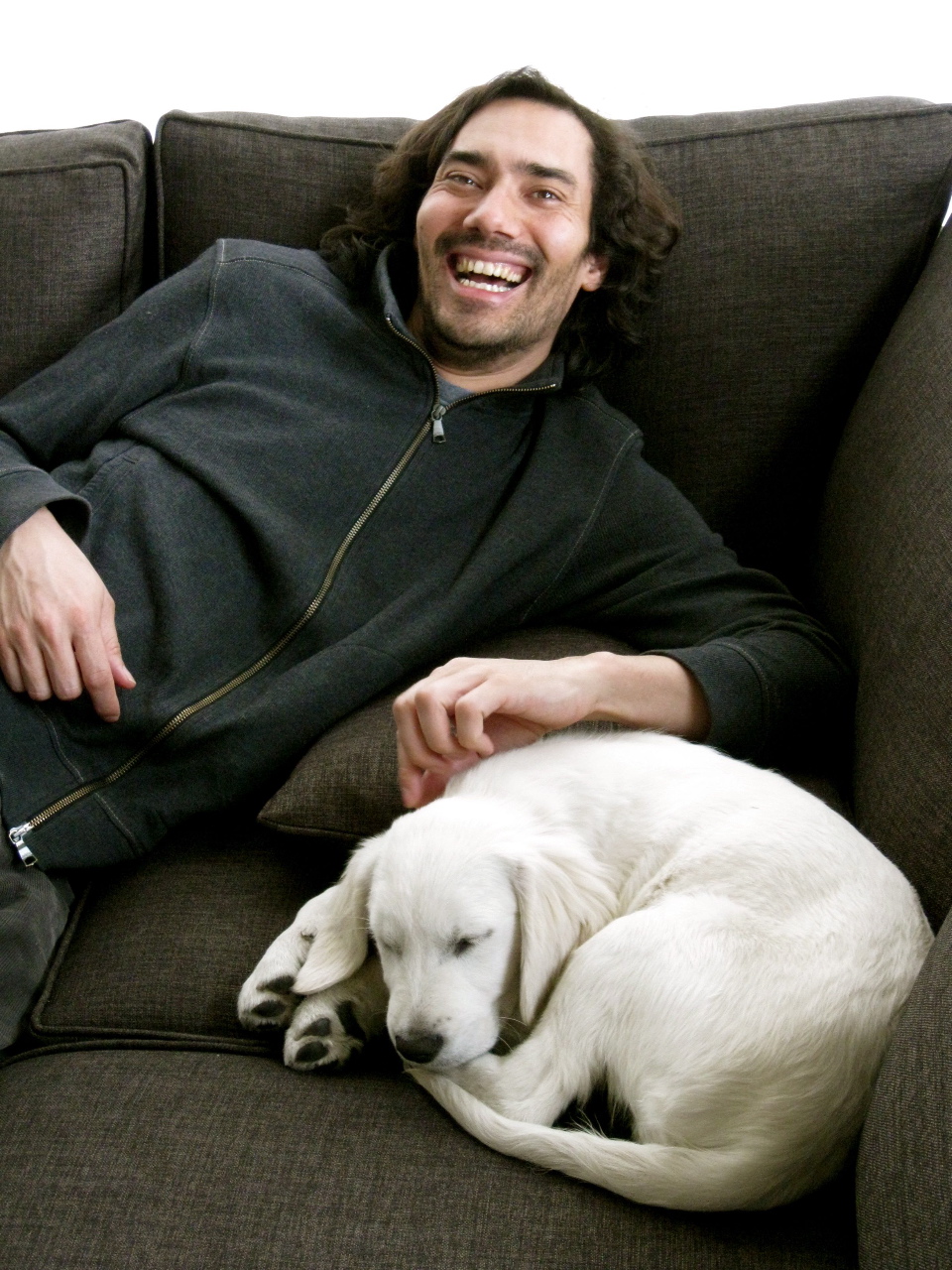 1Q: Tell us a little about the origins of OLD STOCK, from concept to financing.
Old Stock was inspired by our grandparents and the curious thought that it might be nice to retire really early. The film was developed at the Canadian Film Centre in Toronto (Canada’s advanced film and TV training institution) where our writer Dane Clark and producer Geordie Sabbagh were doing a residency. Together we applied to have the film made through their feature film program, funded through Canada’s premier distributors and broadcasters partnered with the CFC. We shot the film in and around Toronto, filming parts of it in a working old age home.
2Q: It appears that the film has been screened at other festivals. Do audiences respond differently at some festivals than they do at others? And do you ever stop being nervous?
I love the experience of seeing the film with an audience. It’s so satisfying to hear the reactions and feel their connection to the film. I’m always surprised at how different moments get a laugh in different rooms. It’s never the same, and it’s a great pleasure to hear a stranger finding a new joke amusing.
3Q: What was your best and/or worst experience while making OLD STOCK?
Much of this film was made from my apartment in Toronto where I live. Countless hours of work on the script, many production meetings, and all the picture editing happened there. I may never make a film at home again but it was a joy to do it this way.

Noah Reid and Melanie Leishman as Stock and Patti
4Q: Festival audiences often have to make hard decisions about what to see, and the catalog descriptions sometimes run together. In your own words, why should people see your film?
We really wanted to make a film that was fun, sweet, and funny, while at the same time showing something familiar about the human experience of letting go of your mistakes and moving on with your life to find love. If these are things that interest you then I’m certain you’ll have a good time.
5Q: There are now so many different ways in which to distribute a film; each has pros and cons. What are your hopes or plans for future distribution?
The film will be released theatrically in Canada in April and I deeply hope that people of all ages and all walks of life will come to see it.
Watch the trailer!
Buy tickets to see OLD STOCK at Cinequest!
 1Q: Tell us a little about the origins of MOLLY MAXWELL, from concept to financing.
MOLLY is loosely inspired by my own experiences at a high school for the “arts and humanities”. I wrote it because I remembered how thoroughly I related to My So-Called Life when I first saw it. It was the only time I’d ever seen anything that resembled my experiences or relationships (other than Twin Peaks of course) and it blew my mind. I wanted to put something out into the world that showed a different kind of high school experience from the one portrayed in mainstream media and I didn’t want to condescend to my characters. The script went through many versions mostly because I had no idea what I was doing. I met Mark Van de Ven in 2008, who became my story editor and later my producer, and he really helped me to shape it and figure out how to preserve the tone and quality of humour that I wanted. John Nadalin and Aeschylus Poulos joined the producing team with their respective expertise to fill in the gaps of knowledge. Once we had a draft we thought represented what I was trying to do, we approached Canadian Film Centre Features, which is a great program here for launching first-time directors. They have been incredible supporters of us and the film along the way. We were very fortunate to get all our financing and even distribution through them from a deal that they’ve established with The Movie Network, Movie Central and eOne.
2Q: It appears that the film has been screened at other festivals. Do audiences respond differently at some festivals than they do at others? And do you ever stop being nervous?
One of the cool things about MOLLY has been watching it with very different audiences. Our premiere was at Palm Springs, which is quite an older crowd, and we just screened at Toronto International Film Festival’s teen-programmed off-shoot, Next Wave. So basically we went straight from an audience of 60+ year olds to 16 year olds. What was awesome about it and really encouraging was that both audiences loved the film and related to it for different reasons. And no, it doesn’t seem that I’ll ever stop being nervous. I hate speaking in front of people, so the intros and the Q&A’s turn me into a wreck. Luckily, our co-lead Charlie Carrick will be representing at Cinequest 🙂
3Q: What was your best and/or worst experience while making MOLLY MAXWELL?
One of the best experiences was shooting the scenes where Ben and Molly go to take photos on Toronto Island. The weather forecast was terrible and we thought it was going to be a disaster, but we rolled the dice and it ended up being just a magical kind of Spring day. It was right in the middle of our very tight, very unmerciful shooting schedule, but this day was pretty unstructured. We took the ferry over and just wandered around with a skeletal crew to the areas that I knew I wanted to shoot, but it was leisurely compared to what we’d been having to get out of our other days. The sun was warm and everyone was in great moods, it was energy-giving and helped us to rally together for the rest of the shoot.
4Q: Festival audiences often have to make hard decisions about what to see, and the catalog descriptions sometimes run together. In your own words, why should people see your film?
It’s challenging, honest, funny and life-affirming.
5Q: There are now so many different ways in which to distribute a film; each has pros and cons. What are your hopes or plans for future distribution?
Because of our deal with the Canadian Film Centre, we had eOne on board as distributor from the beginning. The film will have a limited theatrical release in Canada. Hopefully the film will find an international following online eventually. I know I’ve seen a lot of great indie films that way, such as Weekend and Turn Me On, Dammit.
Watch the trailer!
Buy tickets to see MOLLY MAXWELL at Cinequest!
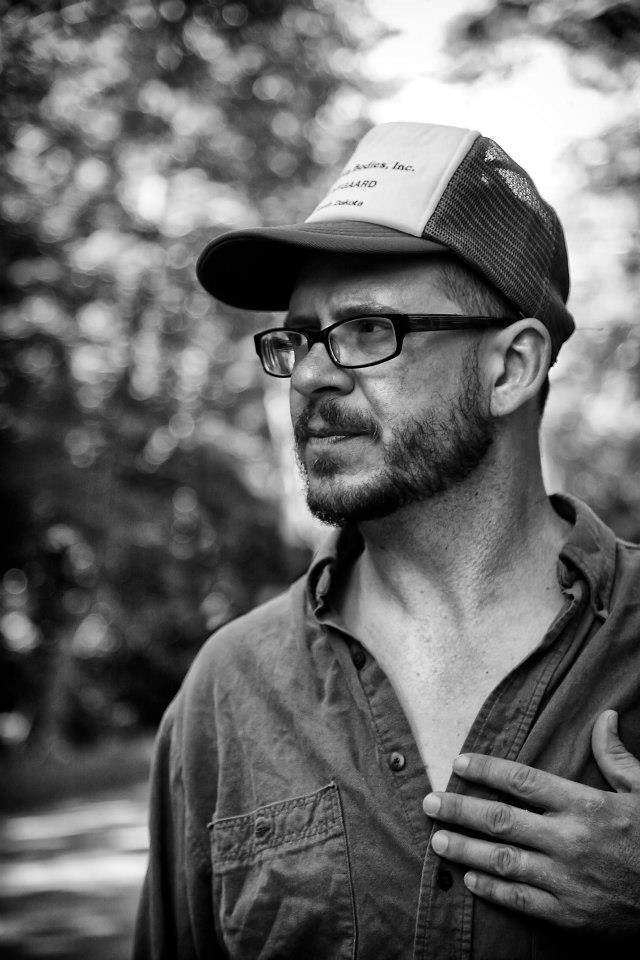 1Q: Tell us a little about the origins of ONLY DAUGHTER, from concept to financing.
Only Daughter was, frankly, born out of frustration. Following my first feature, The Sensation of Sight, I spent some years chasing bigger dollars and bigger names, and ultimately found myself exasperated by the whole thing. So, in May of 2012 I decided that come hell-or-highwater I was going to make something, anything. I conceived of a simple, straight forward story, pulled together some local cast in New Hampshire and we did some workshopping. Then myself and a few other producing partners pulled together an all New Hampshire crew, we set up an indieGoGo campaign, raised $20k in 12 days, and by the end of August away we went, filming for 10 days on 25 locations. It was a wild and sweet little ride.
5Q: There are now so many different ways in which to distribute a film; each has pros and cons. What are your hopes or plans for future distribution?
Watch the trailer!
 1Q: Tell us a little about the origins of WHITE LIE, from concept to financing.
I was on my last year of Met Film School in London when I decided to write ‘White Lie’ as my graduation project. I was studying the thriller genre and researched on the classic murder mystery writers such as Agatha Christie.
Very soon, I got more interested in Christie’s personality as a writer than in her actual books; her incredibly dark sense of humor, her house full of deadly weapons as decoration, she could have been a character in one of her own stories! I immediately decided to write a thriller about murder mystery writers, all set in the house of one of them. Because it was a single-location and felt achievable on a shoe-string budget, I thought I’d be able to film it myself, with a few actors’ friends. It turned out to be much more complicated than what I thought and I talked about it to a friend of mine Thomas Triboit, who worked for Heska Productions in France, and he asked to read my script. Then everything happened very quickly: within a week, Heska read it too, decided to come on board and invested money to make it. We started shooting the day after my graduation screening, and you know the rest of the story!
2Q: Cinequest is proud to host the World Premiere of WHITE LIE. Explain to the audience how you feel about bringing this film before audiences for the first time, and what do you think their reaction will be to your film?
I feel very honored to screen White Lie for the first time in Cinequest, it is incredibly exciting and I look forward to seeing the audience’s reaction, but it’s also terrifying! From my point of view, a film becomes a film the second it gets shown to other people. Everyone worked really hard on it, we’re all very proud and now we just have to let it live its life of its own.
(Obviously, I’ll still be around spying through the keyhole to see the reactions, I can’t help myself!)
3Q: What was your best and/or worst experience while making WHITE LIE?
We mainly shot in this huge manor house in Wales and we also lived there. It was the strangest feeling because it felt like being trapped in the story itself!
We would make tea for the crew in the kitchen and the second later we’d film the character making tea in the same room! This was both the best and worst experience, because it allowed the actors to immerse themselves in the world the film was set in, but on the other hand we were all going a bit crazy stuck with each other 24/7. There was no phone signal and we joked about being on the cover of the local newspapers a couple of weeks later: ’25 people found dead: film crew go insane and kill each other after a month shooting in mansion house’.
On the day off, we all drove to the seaside and I’m convinced it’s the breathe of fresh air that allowed us to carry on making the film.
4Q: Festival audiences often have to make hard decisions about what to see, and the catalog descriptions sometimes run together. In your own words, why should people see your film?
It’s a tough question for me to answer, but I think ‘White Lie’ has a unique tone and atmosphere that hopefully gives an original take on the thriller genre. It can look like we’re inside a Cluedo game trying to work out who’s doing what, only to let us to focus on the relationship between the characters and their feelings.
The beautiful music composed by Rael Jones and the Film Noir look achieved by Pierre Edelmann (Director of Photography) made the mansion house a world of its own, and allowed the actors to give the subtle and ambiguous performance needed in this role-reversing story.
5Q: The current market for independent films is fractured, to put it lightly, and existing distribution models grow more ineffective with each passing moment. What are your hopes or plans for distribution?
My opinion is biased, as the market for independent films is slightly different in Europe than in America. I am lucky enough to live in Paris where indie films are given a chance to get theatrical release. Thanks to our French distributor Franck Llopis (Les films à fleur de peau), ‘White Lie’ will be in cinemas on July 3rd 2013.
However, because the film is in English and is therefore aimed at the international market, we are now seeking Worldwide Sales representation.
Buy tickets to see WHITE LIE at Cinequest!
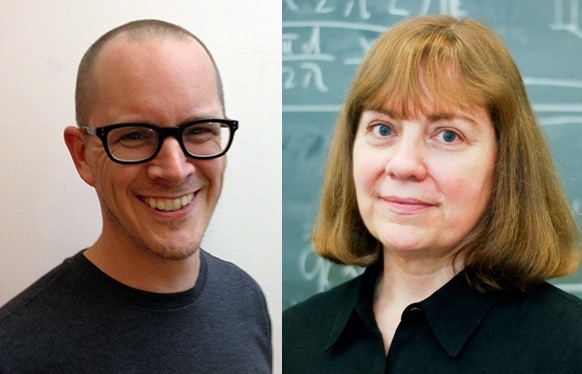 1Q: Tell us a little about the origins of THE BELIEVERS, from concept to financing.
Our first film was a documentary called The Atom Smashers, and it was about physicists at a huge lab near our home town of Chicago searching for an incredibly small particle called the Higgs boson. One thing we noticed was that they were extremely careful when they talked to us, and were reluctant to show much emotion or even say very much about their experiments. We asked them why, and were told “we don’t want to have another Cold Fusion incident.” That got our attention. When we finished that film and it was time to start looking for a new project, we remembered that line. We did some research and soon found out what he was talking about: Cold Fusion was one of the most notorious scandals in modern scientific history. We soon realized that, despite (or maybe because of) the hullabaloo surrounding this event, a small but dedicated group of scientists, engineers, and enthusiasts (including a LA-based talk show host and a high-school honor student from Michigan) still believed that cold fusion was going to save the world. There was even a 25-minute piece about it on 60 minutes claiming “Cold Fusion was Hot Again.” We were hooked.
And it fit with our mission: Our documentary company, 137 Films, is a not-for-profit 501 (c)(3) with a mission of making documentaries from stories we find in the world of science. So, we go looking for great stories that involve science, scientists, and the intersection of both with American culture. The cold fusion episode was right up our alley. It took science, pop culture, the media, greed, utopian zeal, patents, and dreams, and put them all in a blender on high. Unfortunately, when it was all over, two people suffered pretty significant personal consequences as a result, and everyone was a little bit wiser.
Regarding funding, we finance all our films through fundraising events, grants, crowd sourcing, and individual giving. That begins with pre-production and continues throughout production, post, and distribution. The Believers followed that same route.
2Q: It appears that the film has been screened at other festivals; how has it been received? Do audiences respond differently at some festivals than they do at others? And do you ever stop being nervous?
We premiered the film at the Chicago International Film Festival in Oct 2012 and we won the Golden Hugo for best documentary! We’ve had great audiences ever since. University screenings with electrochemical and physics students and faculty in the audience are always fun. But, so too are audiences of “believers,” neutral observers, and downright skeptics. Some people are familiar with the story, others haven’t ever heard of cold fusion. The post-screening discussions are always fascinating. We may never stop being nervous (what if the projection is bad??) but after the many early screenings of different cuts with test audiences, seeing our finished film is more fun than scary.
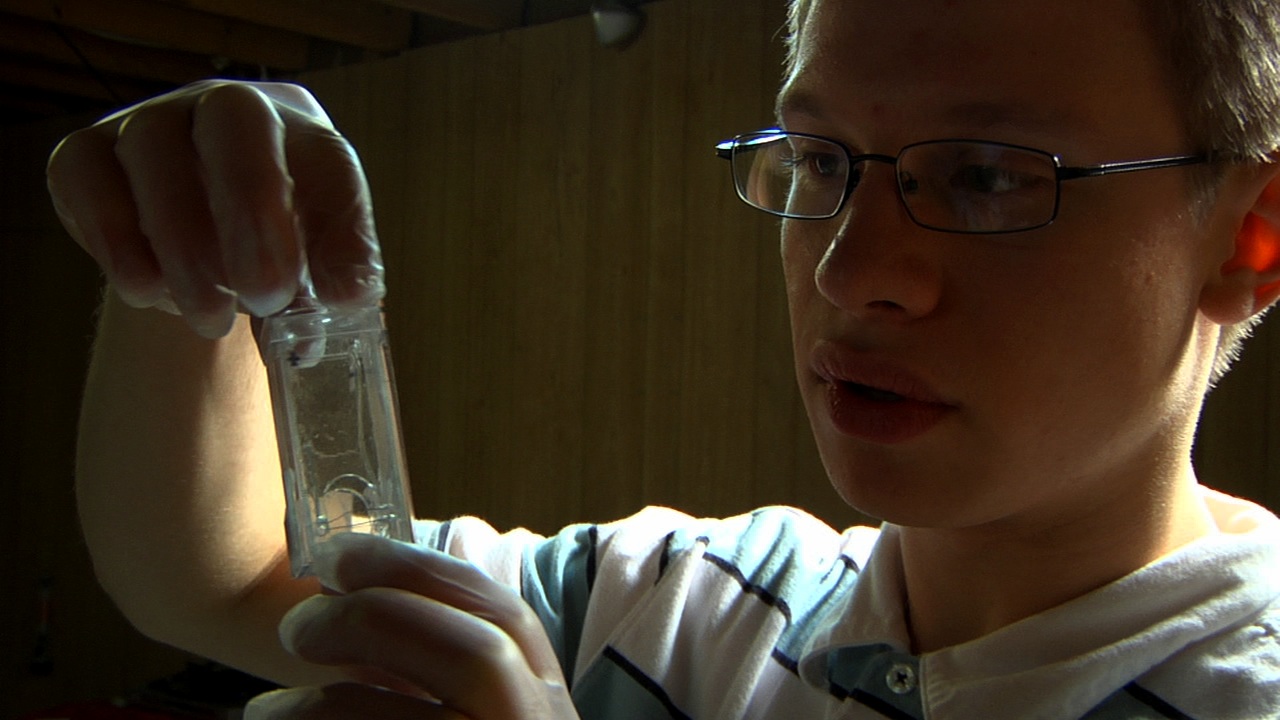
Eric Golab, a high-school honors student in Michigan, performs a cold fusion experiment in his basement.
3Q: What was your best and/or worst experience while making THE BELIEVERS?
So many good moments. We both agree that one of our favorites is the first interview we did for the film. It took place on President Obama’s inauguration day in January 2009 at Dr. Storm’s beautiful mountainside home in Santa Fe, New Mexico. We alternated interviewing Dr. Storms with watching the inauguration. It was a beautiful day and location and seemed an auspicious beginning for what we knew would be a long journey to tell this story. The worst moment was when a subject showed up for a scheduled interview and immediately declared that he couldn’t go through with it because he was afraid he’d be assassinated if he spoke with us! He proceeded to tell us hair-raising stories about people he claimed had been killed for their knowledge of cold fusion, but he wouldn’t tell them on camera. He warned us we might also be in danger and then walked out. Very bizarre.
4Q: Festival audiences often have to make hard decisions about what to see, and the catalog descriptions sometimes run together. In your own words, why should people see your film?
Two people claim they can save the world with sea water and batteries, and embark on a three month rollercoaster ride that changes everything. No one has ever looked at science this way. It’s a mystery wrapped in a drama inside a personal story of greed, discovery, hope, politics, money, pop culture, and scandal. It’s personal, it’s universal, and you don’t need to know anything about science.
5Q: There are now so many different ways in which to distribute a film; each have pros and cons. What are your hopes or plans for future distribution?
Our goal for The Believers has always been to find distribution and get the film out to a worldwide audience using as many platforms as possible, from mobile phone to good old-fashioned TV broadcast. After our win at the Chicago Festival we had several offers for agents and distribution. We are presently comparing the offers of two distributing companies for online and broadcast of the film worldwide; by the time of the festival we should have signed on with one or both. We wish we could get a theatrical deal (who doesn’t?) but that’s probably not in the cards at the moment. However, the Believers DVD will be available soon!
Watch the Trailer!
Buy tickets to see THE BELIEVERS at Cinequest!
 1Q: Tell us how you became involved with 7 LIVES OF CHANCE, and how you prepared for your role.
Well, I knew the director. He is a good friend of mine and he asked me to audition, but I had to agree to cut my hair if I got the part. I did.
2Q: Cinequest is proud to host the World Premiere of 7 LIVES OF CHANCE. Explain to the audience how you feel about bringing this film before audiences for the first time, and what do you think their reaction will be to your film?
I’m excited that this film could get great awards and I think that some people will be like “Wow this is amazing,” because they feel like Chance. Others might say: “Why would she have this problem?” because they don’t have the problem. Chance can’t let go. She can’t forget. She holds onto everything.
 3Q: What was your best and/or worst experience while making 7 LIVES OF CHANCE?
Playing the violin because I like to perform and I like being able to kind of make up my own script. Banks lets me do that. He knows I can make it be me and it will be good and it will still fit into the story.
4Q: Festival audiences often have to make difficult decisions about what to see, and the catalog descriptions sometimes run together. In your own words, why should people see your film?
I think they should see 7 Lives because they will learn to let go if they have that problem and the story is very good and very funny.
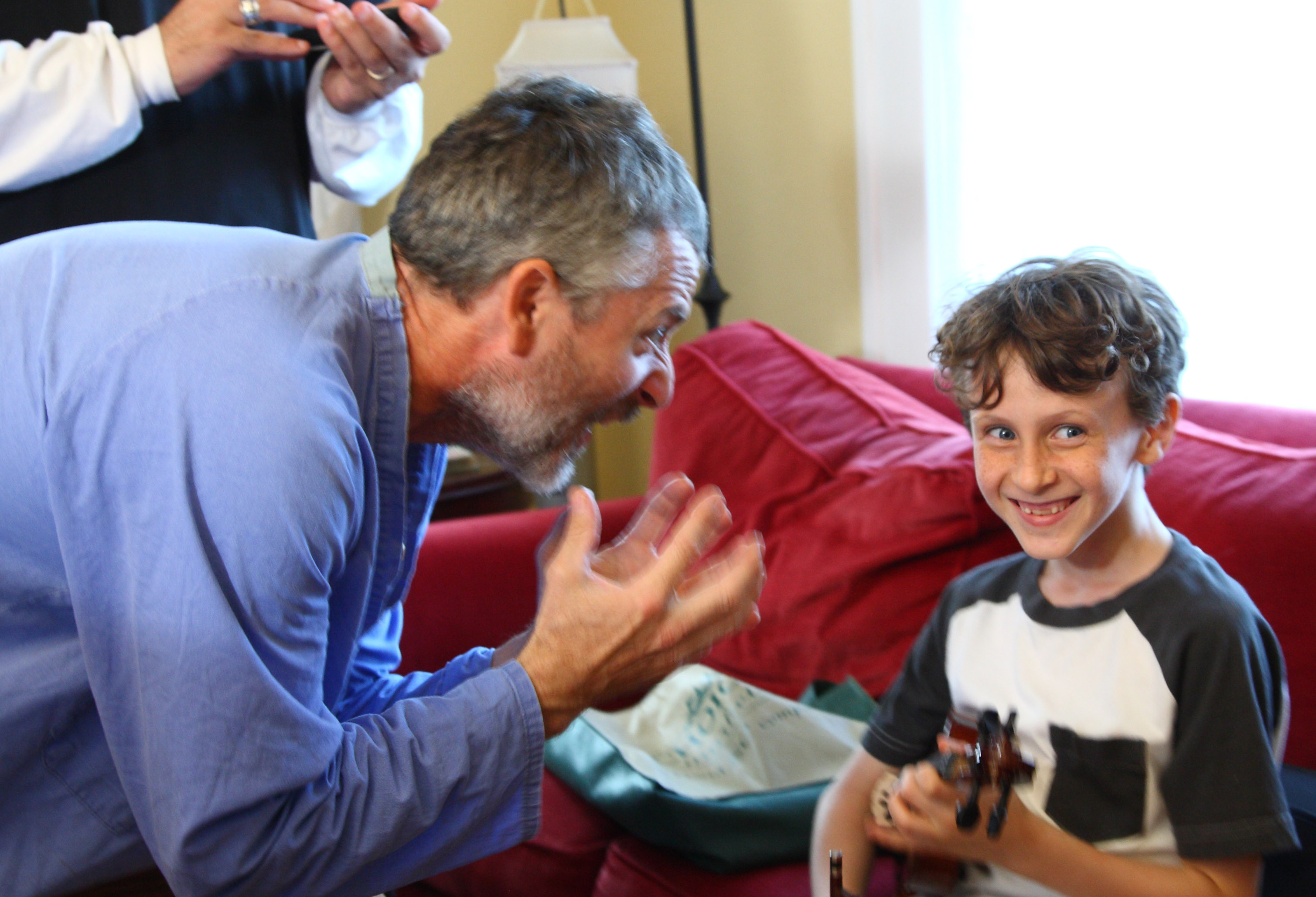 5Q: Tell us your Academy Award acceptance speech:
I don’t really have one, yet. Can I make one up from scratch? OK – “Thank you very much I am so glad I got this prize for my acting and I would like to thank my friends and family very much for their support of me for all my years of acting. I would like to work with Steven Spielberg, but he’s too old. So maybe I can work with David Yates.”
Buy tickets to see it at Cinequest here!
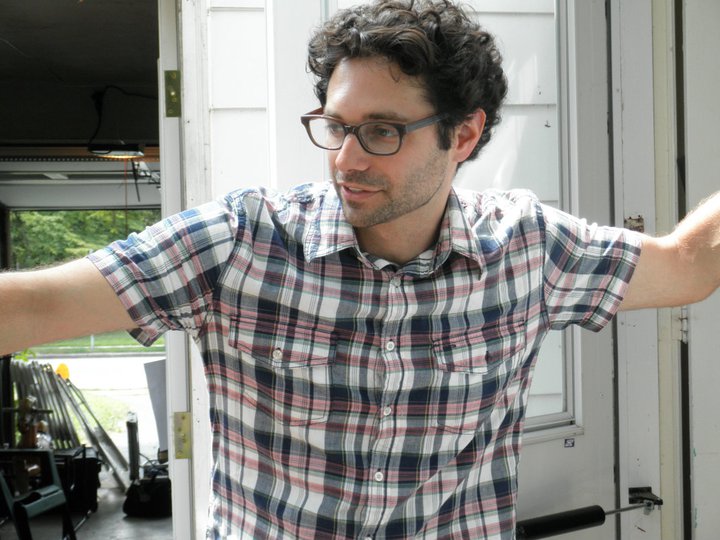 1Q: Tell us a little about how you came to be involved in DETONATOR.
Keir had this idea about two old friends in trouble with a dangerously twisted old punk named, Dutch, who ended up being embodied by the amazing Robert Longstreet. Both of us had been working on each other’s scripts for years and were waiting around for things to get funded. Keir had a connection to a “name” actor who used to be in a well-known TV drama and was told to get the script ready in like 16 days. We were talking about how he could do it and right then and there decided to write it together. We wrote the first draft in about 14 days. I don’t think it even found its way into the actor’s hands, but we both got really vested in the world and its characters. Around that time we were both talking about our lives and respective families and Keir was about to have his son, Lorenzo. It all felt very personal and we decided we had to pool our resources and make it happen ourselves. Long story long, we found two great actors (Lawrence Michael Levine and Benjamin Ellis Fine) and shot a preview trailer over a frigid night in Philadelphia. We used that preview to raise the seed money and it grew from there.
Q2: Cinequest is proud to host the World Premiere of DETONATOR. Explain to the audience how you feel about bringing this film before audiences for the first time, and what do you think their reaction will be to your film?
I’m very excited to have people see the film, react to it and make some sort of connection. I expect anything but indifference.
3Q: What was your best and/or worst experience while making DETONATOR?
My best experience was collaborating with our DP, Michael Cano and our great actors, Lawrence, Ben Fine, Sophia Takal, Dawn L. Hall, Robert Longstreet and Joe Swanberg to name a few. Despite all the rumors and gossip about two directors 🙂 Keir and I are very close and it was fun that we both had our own relationships with everybody and got on as one big family. When everything was clicking it felt like a high functioning three ring circus.
There were gunshots and car chases on the streets of Philly, but my worst experience was, no doubt, driving around the city. I was staying in the cast house with many of our actors and because of the film’s budget I was not only a director, but also a driver. This compromised some of my relationships.
4Q: Festival audiences often have to make hard decisions about what to see, and the catalog descriptions sometimes run together. In your own words, why should people see your film?
This film’s got something I know some people will want to see because I know I’ve been waiting to see it. It’s a punk rock thriller
about toxic friendships, high stakes, family and loss. Maybe people can check out our trailer.
Q5: There are now so many different ways in which to distribute a film; each has pros and cons. What are your hopes or plans for future distribution?
Surprisingly, after beginning my life in film shooting on 16mm and editing on a flatbed, a moviola to be specific, I feel more comfortable than ever with the new media landscape. I’m less discriminative of the size of the screen and just want to tell a story. Maybe I have to lie to myself, but I figure we found a way to make this film so now we’re gonna find an audience. Feeling so personal about this film means I can live with it for a couple of years.
 1Q: Tell us how you became involved with 7 LIVES OF CHANCE, and how you prepared for your role.
I’ve known Banks, the director for a few years. We’ve worked together on some smaller projects in the past. Banks had asked me to watch a rough cut of his last film, The Ah of Life, which I did. We had some long talks about the direction he was taking that film. Then I went to the first screening of that film when it was complete and I really thought he did a great job with the final cut. I appreciated that he expected my input and I felt like we could work well off of each other. So I pulled him aside at the screening and told him I want to be in a little sooner on the next one.
2Q: Cinequest is proud to host the World Premiere of 7 LIVES OF CHANCE. Explain to the audience how you feel about bringing this film before audiences for the first time, and what do you think their reaction will be to your film?
The whole cast and crew are thrilled to screen this film at Cinequest. This film is made for thinkers. There is a lot going on in this film and some of it the audience will have to figure out on their own. We wanted it that way. If the audience stays on their toes, they are in for an emotional, entertaining piece of film.
 3Q: What was your best and/or worst experience while making 7 LIVES OF CHANCE?
The worst part was being haunted by balloons for over a week. On set balloons were everywhere, and since Banks would often stop by my house for different reasons, he would also leave balloons around for my kids. So I would spend 12 plus hours around balloons all day just to come home to even more balloons at night. I started feeling like Chance. It is pretty damn funny that our DP Ryan has a fear of balloons.
The best part is just seeing people come together and work so hard. A select few often get the credit for making a film, but the truth is it wouldn’t be possible without every last person giving it their all.
4Q: Festival audiences often have to make hard decisions about what to see, and the catalog descriptions sometimes run together. In your own words, why should people see your film?
This film deals a lot with death and losing people close to you. That’s something every one of us have or will have to deal with. This film handles it in such an entertaining, funny and sometimes ridiculous way, it makes it easy to accept. You’ll find yourself crying one minute, just to laugh the next.
5Q: You have a long list of IMDb credits. Was working with director Banks Helfrich a different experience from working with other directors? Tell the craziest story you know about Banks. I know you must have at least one.
Working with Banks is awesome, it really is like being on a roller coaster. As far as a crazy story, maybe I will take this opportunity to tell Banks: buddy, you can stop handing out balloons to every person you meet, everywhere you go. Unless of course you have stock in the company or something.
Buy tickets to see it at Cinequest here!
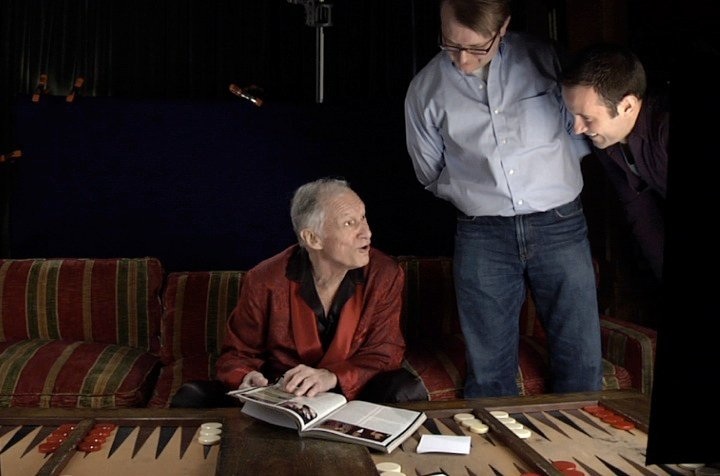
Tom Bean and Luke Poling with Hugh Hefner
1Q Tell us a little about the origins of Plimpton! Starring George Plimpton as Himself, from concept to financing.
LUKE POLING: I had always been a fan of George’s work and when Tom and I hit upon the idea, our first thought was, “why hasn’t anyone done this before?” We contacted Sarah Plimpton, George’s widow, and she not only said go ahead, but she gave us access to George’s archive of audio, video and film, a lot of which, no one had ever seen in a very long time.
2Q: It appears that the film has been screened at other festivals. Do audiences respond differently at some festivals than they do at others? And do you ever stop being nervous?
TOM BEAN: I’m not sure if this feeling wears off later on in people’s careers, but since this is our first film, it never stops being exciting when we get into a festival. I haven’t noticed a strong disparity of opinion geographically or from festival to festival, but each person seems to find different things they like about the film (or think could have worked better). In all, it’s been a pleasure to share the film with folks. And, no, I haven’t stopped being nervous about how each new screening…
3Q: What was your best and/or worst experience while making Plimpton! ?
TOM: It took us several years to make the film, so there were a number of peaks and valleys along the way. For me, one of the best parts of making an historical film like this was doing all the research and finding the archival material (searching through archives and libraries, digging through boxes in Plimpton’s old office, discovering letters, photos, etc). The other part I loved was meeting and learning from all the fascinating people who inhabited George’s world (including his wonderful family).
4Q: Festival audiences often have to make hard decisions about what to see, and the catalog descriptions sometimes run together. In your own words, why should people see your film?
LUKE: You will learn things watching our film. How to box a light heavyweight champion. How to act alongside John Wayne. How to play percussion for the New York Philharmonic. How to throw great parties. And how to live one of the most fascinating lives anyone has ever seen.
5Q: There are now so many different ways in which to distribute a film; each has pros and cons. What are your hopes or plans for future distribution?
TOM: We’re going to be doing a theatrical release of the film starting in late May (Laemmle/Zeller Films is doing the distribution), which we’re very excited about.
Watch the trailer!
Buy tickets to see Plimpton! Starring George Plimpton as Himself at Cinequest!
Buy tickets to see Plimpton! Starring George Plimpton as Himself at the Atlanta Film Festival!
 Popcorn and Vodka