 I don’t know if I have enough time to write the review this film deserves, so let me start with this: As of this moment, DOWN RIVER is my favorite film of Cinequest 2014, and I plan on getting the DVD just as soon as one is available. So put it on your schedule, ASAP. Now let me try to do the film justice.
For some reason, several of the Cinequest blurbs about the films are just not accurate. So ignore what it says for DOWN RIVER. This film is about four women who live separately in an apartment building. Three women are younger (mid 20s to mid 30s?) and Pearl is 60. Harper is a bisexual (struggling) singer in a band, Fawn is a (struggling) actress, and Aki is a (struggling) artist. All three visit Pearl on a regular basis to get life advice, but none of them know that Pearl is struggling with the news of terminal cancer and won’t be with them for much longer. The film follows all four of the women in their lives and their struggles, and their friendships.

Oh Fawn.
This drama has very intriguing female characters, and passes the Bechdel Test with flying colors. Yes, they each have a relationship with a man (a father, a boyfriend, a husband and a friend), but their lives revolve around their careers and their relationships with family and friends. These are all strong, intelligent women, even when they are failing. The very talented actresses are good looking but not unattainably gorgeous, so they are extremely relatable to everyone. But let me get back to the talent again… the four main women and the supporting cast are all amazing, and I was constantly struck by how real their performances were.
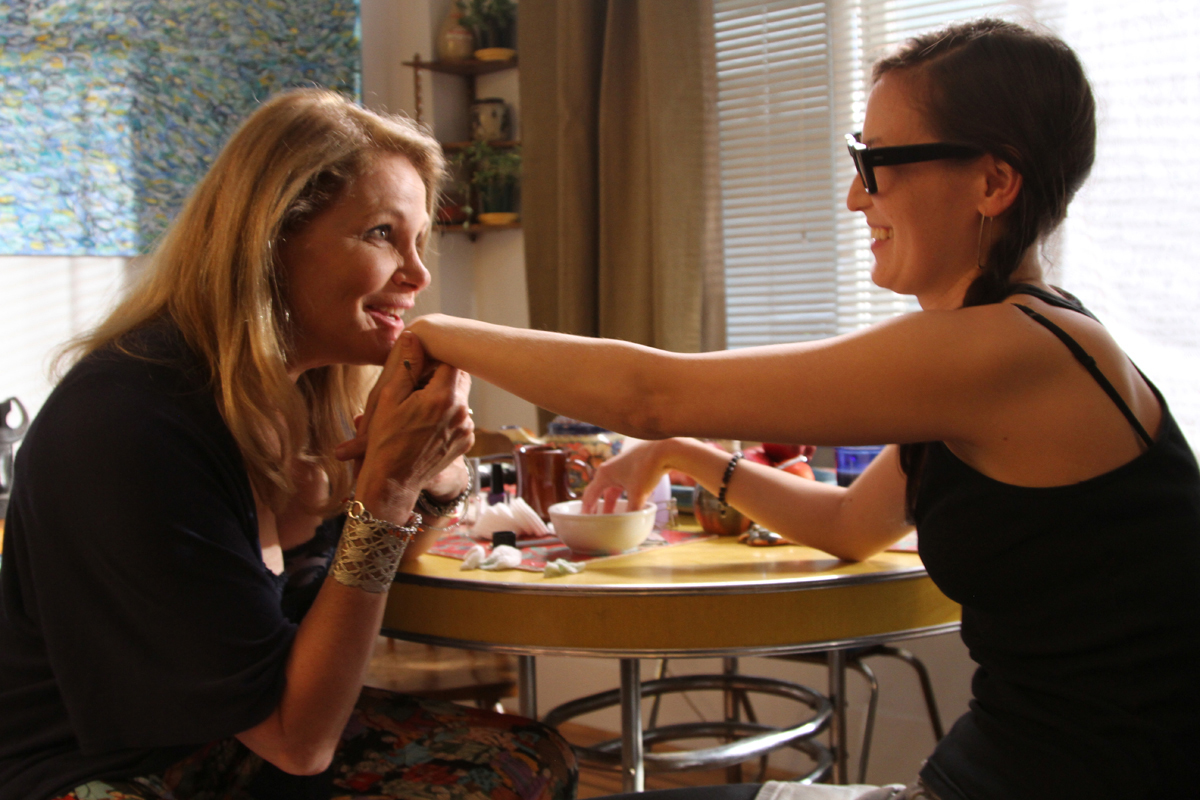
Pearl gives Aki advice, again.
Pearl decides to keep her health issues to herself, and she deals with her cancer without any melodrama even though she is obviously in pain. She is so subtly dealing with the pain and her lack of a future that I had a constant lump in my throat watching her go through it.
I can’t really say this is a sad film, and it certainly is not depressing. There are constant hilarious moments, truly laugh out loud lines, even in the midst of the drama. But everything is very real and true to life. The women have failures and several very real problems in their lives that every woman can relate to, and sometimes they deal with those problems by crying, sometimes by kicking and screaming, but always they pick themselves up later and try to get back on track.

Harper kisses Molly
But Pearl isn’t going to be able to get back on track, and that constant knowledge keeps your laughter in line. And as you see how big a part Pearl plays in these women’s lives, you start to feel very empathetic knowing what they are about to go through.
In the end, Pearl is able to give them each a gift – one last piece of advice she has for each individual woman. As the movie played its final minutes I was sobbing uncontrollably, but with a huge smile on my face. You can be sad that Pearl’s life is going to end, but you have to be happy that she was able to affect so many lives, and in a way that she will always live on in these women’s hearts. Pearl’s life is ending, but these women are going to continue with theirs, and they will be so much the better for having known Pearl. So I could not help but have this huge smile on my face while I was a big blubbery mess of tears. I don’t even LIKE films that make me cry, but this film was truly full of hope and happiness and a love of life.
But bring a hanky.

Babz Chula
The film was written by Benjamin Ratner, whom I interviewed last month. The film was inspired by a friend of his, Babz Chula, who recently died from cancer. The interview made me teary back then, and you should read it before you go if you can (and if not, read it after). Ben is a very talented writer, able to come up with this very truthful and real story of women’s lives in such a funny and dramatic way.
But he must also feel incredibly lucky to have landed every one of his actors. Helen Shaver (Pearl) shows the age of 60 to be just too young to die, and the film revolves around her nuanced performance. Gabrielle Miller plays the sweet, God loving Fawn, and also deals with some very real problems and conflictions that many married working women do. Jennifer Spence is tremendous as the usually composed Aki, and does great in her scene of morning after regret. Colleen Rennison won my heart as the troubled Harper, and her velvety voice truly melted my heart. She continually amazed me in every single scene (like seriously, I want Harper to be my real life friend). The supporting actors are no less talented, with special note given to the hilarious Brian Markinson (Otto), the wonderful Teach Grant who plays Harper’s boyfriend as an asshole who has every right to be, and most especially, Jay Brazeau as Pearl’s friend Larry. Every scene with Pearl and Larry touched me, and now I have to get a brandy snifter just so I can remember these two every evening.
The film, the actors and the characters are all Amazing and Intelligent and Funny and Heartbreaking and Truthful. I feel very lucky to have seen the film, and I hope everyone feels the same way. Put it on your schedule, and bring a hanky, but don’t worry about being depressed, I promise you’ll leave with a smile on your face.
My interview with director/writer Ben Ratner.
See DOWN RIVER at Cinequest!
“Like” DOWN RIVER on Facebook
Ben Ratner on Twitter
DOWN RIVER on Twitter

Sarah Smick
1Q: Tell us a little about the origins of FRIENDED TO DEATH, from concept to financing.
.


Christopher Graham

Joseph Arney
1Q: Tell us a little about the origins of NOBLE FIR, from concept to financing.
Growing up in rural Oregon provides one with a lot of inspiration. We’ve been pals since childhood and have always been inspired by similar themes. Many of these themes are profoundly represented within the context of a Christmas tree farm. Having had grandfathers and uncles who have made their living from owning and operating tree farms, we didn’t need to look too far for inspiration. We wanted to tell a story that represents the Oregon we grew up with: beautiful, rugged, tragic–full of strong men who suffer pain silently.
Once we had our story, we began to assemble our crew. We brought in talented friends and family whose enthusiasm exceeded our own! We financed our film with their generous donations and a few credit cards. We benefited from all the goodwill within the small town we grew up in. People were donating their properties, vehicles, and businesses to help us make our film–overwhelming us with their generosity.
We chose to tell the story in a hyper-realistic style. We truly respect the Dardenne brothers and the films of the Romanian New Wave and hoped to capture a bit of that same spirit while not losing our own voice in the process.
2Q: Cinequest is hosting the World Premiere of NOBLE FIR. Explain to us how it feels to bring this film before audiences for the first time, and what do you think their reaction will be to your film?
Frightening. Exciting. Disconcerting. Relieved. We feel honored and humbled at the same time.
What do we think the reaction will be? Well… we hope we aren’t trampled by angry cinephiles demanding their money back. We hope our parents don’t regret the money they spent on our film degrees. Kidding (we don’t have film degrees)! We hope it touches audiences and makes them think. We hope there will be a few tears and a few laughs and we hope that at least a few will want us to make another film.
3Q: What was your best and/or worst experience while making NOBLE FIR?
The best has to be turning the town we grew up in into our own personal playground. For nearly three weeks we ran around filming in our old stomping grounds. Seeing people we haven’t seen in 15 years. Much of the creative team grew up making videos together. After high school, we all went off to different schools and began our careers in various art-driven fields. When we informed them that we had a feature we wanted to shoot, nobody hesitated: they dropped everything and brought their insane talents back home where it all started. At the risk of sounding cheesy, it was exactly how you’d dream it would be: surrounded by our closest friends, playing make-believe out in the woods all day. We owe a huge thank you to all the wives and girlfriends who let their guys drop off the earth for three weeks. Many of them brought their talents to the shoot as well.
We really can’t think of any bad moments on set…. Well, maybe one: we had hoped for typical Oregon weather: overcast, threatening to rain or drizzle, but always overcast. In Oregon it’s possible to see rain, sun, and snow on the same day. You can stand outside and bask in the sun while being rained on at the same time. It’s great! We had the ability to adapt to all weather conditions except snow. Guess what we woke up to for two days of the shoot? But everyone pulled together and we made the most of it. Even provided some amazing images. So the worst experience really wasn’t so bad.
4Q: Festival audiences often have to make hard decisions about what to see, and the catalog descriptions sometimes run together. In your own words, why should people see your film?
Noble Fir touches on both personal and universal themes: anger, grief, suffering. These emotions can be difficult to deal with or even talk about. Many of us try to push them away or hold them down until they give up struggling. But they still remain below the surface. We think the film presents a perspective not often seen in our culture today and we hope it gets people thinking about what they’re battling… and whom.
5Q: Time to pre-plan: You just won an Oscar for NOBLE FIR. Give us your acceptance speech.
We’d like to thank the Academy for continuing their esteemed Technical Awards dinners. If not for the innovative use of our “tree-cam” we would never have had a chance to appear in this brief montage to be aired right before the commercial break on the 88th Annual Academy Awards show. We’d like to thank our amazing and delightfully incongruous hosts, Lorenzo Lamas and Adam Richman. And our compliments to the chefs for baking the potatoes just twice enough. Thank you!
See NOBLE FIR at Cinequest!
Watch the trailer!
“Like” them on Facebook!
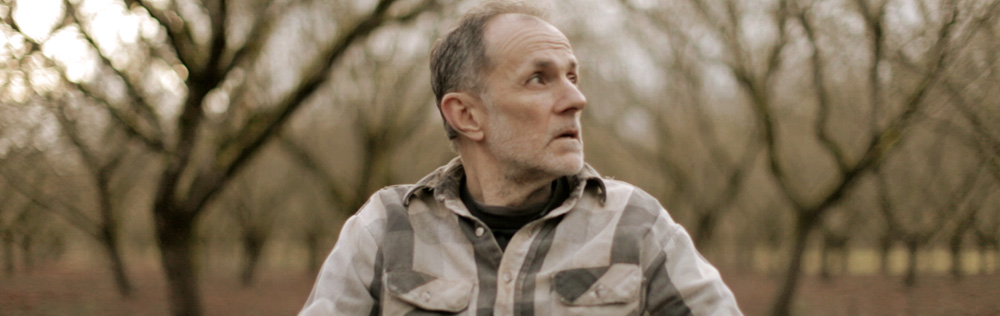

AS IT IS IN HEAVEN is a very interesting, intense film. It is about a small religious group, guided by an elder “prophet”. The film begins with the baptism of David (Chris Nelson). Right away I thought this was an interesting choice for a beginning. Baptisms, both literal and metaphorical, usually signify a major change in a character’s life, the big plot turning point in a film. But in this case it is used to show us David’s new beginning and his entrance into a brand new life. But then we race forward several months and the prophet has announced that the Rapture is coming in just one month. Many preparations are to be made for their entrance into heaven, not least of which is the acceptance of the belief that it is really going to happen.
There are many stumbling blocks along their path of faith. Almost immediately the prophet takes ill and passes away, informing David he is the new prophet who must lead the group to the next life. But jealousies get in the way and doubts cause violent breaks of faith. Many in the group question both the coming Rapture and David’s role as the prophet. And in the end we find out what happens at the appointed date, and how David handles it all.
The film is not filled with religious preaching, rather it is an examination of human faith and the need for meaning in life, and in death. It questions how far humans will go or not go to express their faith, and when the path is filled with barriers, how they choose to overcome them. Even (and perhaps especially) the question of leadership is brought up, whether we accept it or not, how and why we make the decision of who, and whether they are needed.
The film itself is dusky and beautiful, and the mood is set with beautiful strings in the background. The acting and direction is intense, and the film gives you several things to think about as you somberly leave the theater.
Watch AS IT IS IN HEAVEN at Cinequest!
“Like” it on Facebook!
My interview with director Joshua Overbay.

LOL.
I mean seriously, LOL.
This film is so awful it’s just about perfect. And I mean that in the best way possible.
Look, I grew up in the 80s, I LOVED the 80s, and the 80s actually had some really great music, film and fashion.
It also had some of the worst music, film and fashion in history, no joke.
ETERNITY, because I’m 99% positive they meant it to be awful, hits every level of this.
Todd Lucas (Barrett Crake) and BJ Fairchild (Myko Olivier) meet in the 80s and decide to form the greatest R&B band in history, Eternity. The film follows their rise to fame and fortune, their loves, their lusts, their friendship, and finally their falling out and inevitable reunion.
ETERNITY: THE MOVIE is not a tribute to the greatness of the 80s. I could very well be wrong, but I really think it’s a tribute to the awfulness of the 80s. There was some really horrid music on the radio back then, and you’ll hear some very similar music in this film (although I actually like the last two songs of the film). 80s fashion could be mind bogglingly terrible, especially for men – and it’s here in all its cheap glory. Don’t let nostalgia fool you, 80s television was not what you remember either. And ETERNITY has all the overdramatic arguments from the after school specials, a melodramatic dying scene straight from the nighttime soaps, and the subtle undercurrent of homosexuality blatant homoerotic tomfoolery of the entire decade times infinity. There is bad acting, bad writing, bad sex jokes, bad ideas and Ridgemont High. Wait, Ridgemont High is awesome, what wasn’t awesome were all the copycat movies that came after it.
That’s what ETERNITY is, in the most perfect way.
Would *I* watch it again? LOL. No. But I know a lot of people who will love this film and will want to watch it over and over. “I get it now, I get it,” says one character near the end of the film. “I don’t,” replies Gina Marie (Nikki Leonti) and I started cracking up. Because that kind of summed up the movie. I think there is going to be a section of the audience who will be rolling their eyes at this film, and then there is going to be the much larger section cheering and cackling with glee. It’s all done in good fun, and I think they absolutely accomplished what they were trying for.
See ETERNITY: THE MOVIE at Cinequest!
My interview with the filmmakers!
“Like” them on Facebook!
Follow the film on Twitter!
 .
.
I finally had my first big belly laugh just eight minutes into LAWRENCE & HOLLOMAN, and the laughs just kept coming in this must see dark comedy.
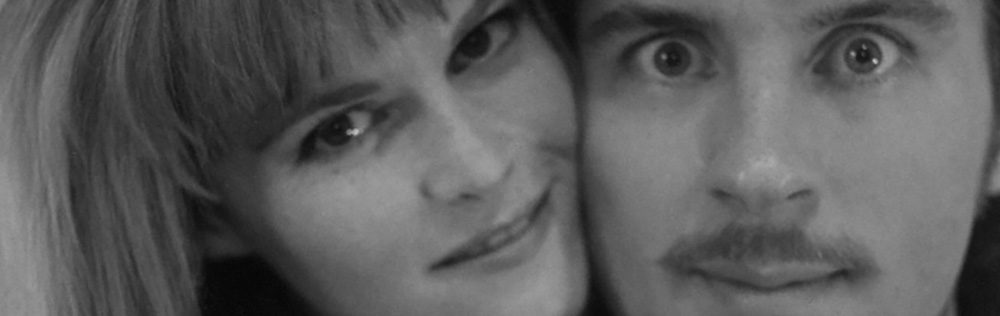
Holloman is a white bread and bologna type guy who just cannot win in life and intends to end his troubles, permanently. But before he gets a chance he comes across the vocabulary challenged Lawrence who seems to win at EVERYTHING in life without even trying. Promotions at work, great apartment, sexy girlfriend, and the adoration of everyone he comes across. Lawrence is everything Holloman is not.
Holloman decides to follow Lawrence and see what his secret is. Is it just the luck of a shiny new penny? Lawrence’s endlessly optimistic outlook? Fate? Lawrence takes Holloman under his wing and tries to teach him the benefits of looking on the bright side of things.
But suddenly, Lawrence’s luck takes a downturn just as Holloman’s life appears to be suddenly looking up. What will it take for Lawrence to lose his optimistic outlook? Is there a reason for the change of luck, or is it the fault of the mysterious mustachioed man?
Daniel Arnold and Ben Cotton are perfectly cast as the unlikely duo. Arnold morphs believably from a sad loser to a handsome man of luck, and Cotton just continues to be the insufferable optimist no matter how many anvils fall on his head. The comedy is dark and so well written with that trademark humor I’ve come to expect from Canadian films. I really enjoyed this film and I know Cinequest audiences are going to love it as well. Put it on your calendars and get ready for those belly laughs!
See LAWRENCE & HOLLOMAN at Cinequest!
View the Trailer!
“Like” them on Facebook!
Follow them on Twitter!
My interview with director Matthew Kowalchuk
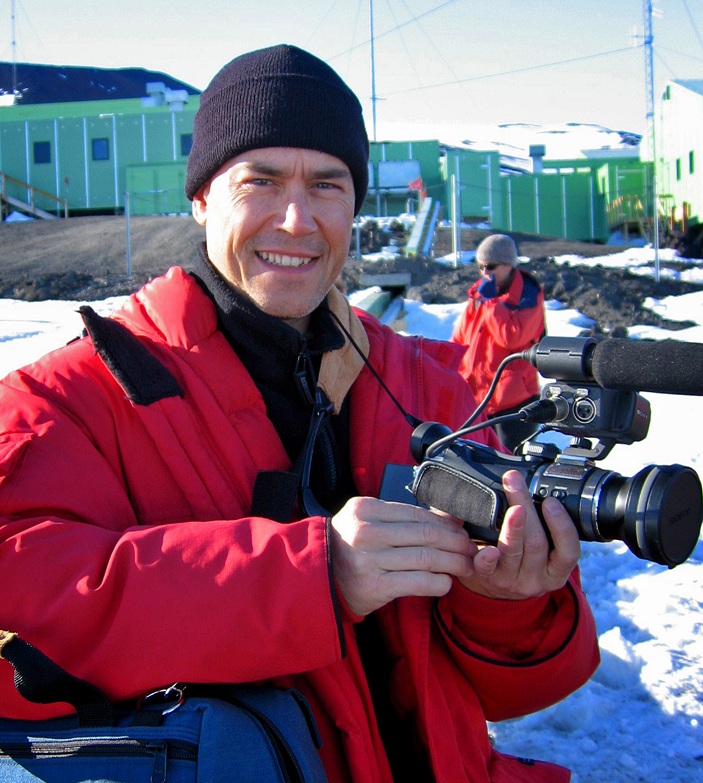
Paul Devlin, director
1Q: Tell us a little about the origins of THE FRONT MAN, from concept to financing.
Thirteen years ago, I tried to create a fictional character for a screenplay based on my buddy Jim Wood [from Loaded Poets]. I’ve known Jim since kindergarten and he’s always been the most charismatic, clever, humorous person in the room. All of us have known someone like Jim growing up – that guy who will definitely be famous someday.
But my attempt to convey his character in fictional form fell short. So I decided to start shooting him on video every time we got together. That made more sense anyway, given my background as a documentary filmmaker. Of course Jim loved the idea, though we had no specific goal in mind beyond laughing a lot and capturing some great moments.
While I continued making other films, I kept returning to the The Front Man. Soon, I got deeper into the lives of Jim and his wife Christie, as well as Jim’s bandmates John Kayne and Dan Snyder. Story threads emerged that we could never have anticipated. I added archival footage to the mix and this haphazard project gradually took on epic proportions as I essentially captured Jim’s entire adulthood over a 27-year period. The Front Man supports the idea that any well-documented life can provide material for a compelling story.
Even more gratifying were the profound thematic undercurrents that emerged by following Jim for decades. The Front Man raises compelling questions about how any artist measures success. Is the purpose of creative endeavor personal satisfaction or to communicate to the widest audience possible? Can an artist balance his or her work with a family and well-paying day job, or do these represent dangerous distractions from the primary goal of attaining riches and immortality through artistic achievement? What if the success you seek is not the success you achieve? If you’re not famous, have you failed?
The Front Man tackles these timeless but elusive questions head-on. It does so not by interviewing expert talking heads, nor by surveying dozens of artists. Instead, by following one man over the course of most of his adult life, The Front Man takes a more ambitious, in-depth approach. Through this singular personal story, The Front Man discovers universal insights
2Q: Cinequest is proud to host the World Premiere of THE FRONT MAN. Explain to us how it feels to bring this film before audiences for the first time, and what do you think their reaction will be to your film?
We love the love we’re feeling from Cinequest and feel very much “at home” premiering the film here. We think our film is basically everyone’s story, so we expect the audience will like what they see in this mirror.
3Q: What was your best and/or worst experience while making THE FRONT MAN?
The best experience was keeping in close touch with the subject, Jim Wood. It was also the worst experience.
4Q: Festival audiences often have to make hard decisions about what to see, and the catalog descriptions sometimes run together. In your own words, why should people see your film?
How many documentaries can claim to be comedies, How many explore the arc of a romantic relationship over decades? (You mean it’s a love story and a comedy and a documentary??!!) How many documentaries make audiences re-think what a documentary can be?
Quite simply: The Front Man is your story. It is downright fun. It is poignant. It will stay with you and tap your brain on the shoulder as you carry on with your life.
5Q: Time to pre-plan: You just won the Best Director Oscar for THE FRONT MAN. Give us your acceptance speech.
Thank you!!!! This Oscar is officially for sale in order to crawl out of debt from this film.
See THE FRONT MAN at Cinequest!
View the Trailer!
 .
.
Let’s say you get the director of the Peter Rabbit TV series, the writer of Mini Adventures of Winnie the Pooh, and the cast of Power Rangers R.P.M. What kind of movie would you expect? If you said “Why, a Ground Hog Day with murderous crackheads, obviously!” You would be correct. If you said, “Oh, some cross between a romance, a comedy, a drama, a thriller and a horror film, for sure,” you would also be correct.
If that all sounds very confusing and full of nonsense to you, welcome to Blood Punch.
Now let’s be clear, this film was highly recommended to me by Christopher Garcia, and because I normally respect his opinion, I wonder if I was just in the wrong frame of mind when watching Blood Punch. However let’s remember that Chris also enjoyed Puck Hogs. So. There’s that.
Blood Punch opens up in a meeting of NA for the healthiest looking crackheads ever meth addicts, which it turns out is a great place to find people to cook up your large order of crystal. Beautiful Skyler (Olivia Tennet) manages to convince meth chef Milton (Milo Cawthorne) to come with her to a cabin in the middle of nowhere to cook up the massive order as their Last Job. Unfortunately, Skyler’s crazy boyfriend Russel (Ari Boyland) is also at the cabin, with murder on his mind. What they soon discover though, is that regardless of who murders whom or not, they all wake up in the morning back in the cabin and all alive. Attempts to leave the cabin don’t work, and multiple, endless attempts to kill Russel in different ways without getting killed themselves also don’t work. So they are all trapped in an endless loop of killing each other with no end in sight and no way out.
An interesting concept, and it certainly brought up some interesting philosophical questions about life, death and murder. But this was all overridden by the multiple genres this film was trying to fit into. Early on I was confused about whether this was a romance, a comedy or a drama, and upon looking up the Cinequest listing I noted it under the headings: Thriller, Romance, Comedy. I suppose this combo can work, I mean Evil Dead II is sort of a Thriller-Romance-Comedy. But in the end, there is no real point to Blood Punch, it doesn’t have anything to say and there’s no real enjoyment in the process of solving the puzzle. In Ground Hog Day, Bill Murray had to learn a lesson before he could continue with his life. There is no lesson to be learned here, the only mystery is the murder combination riddle. I don’t think any character learns anything, no one grows, and there’s no real suspense involved since we know they’re all going to wake up again the next morning.
This film is not Groundhog Day, and neither is it Evil Dead II. It’s not even a wannabe Breaking Bad. It suffers from its own identity crisis, the actors can’t quite save it, and I can’t in good faith recommend it. I will give it a rare benefit of the doubt however, and say that Chris loved it, so if you want to give it a try, don’t let me turn you away from it. I just think there are probably better films available – and I intend to watch one right now.

Dana Nachman, director
1Q: Tell us a little about the origins of THE HUMAN EXPERIMENT, from concept to financing.
I was a producer for NBC Bay Area and I was assigned a series about keeping your home toxic free. It was through that story that I learned that most products that we have in our homes are not tested for their safety before they get onto the market place. I didn’t believe it was true and after a little bit of research I realized it was true! When I’m shocked about something it usually turns into my next documentary.
This film took a lot of research and a lot of pre-production because it is such a massive topic. I am not a lifelong environmentalist so it took me a while to understand and come to know the players working on this issue and it took a while to figure out which people and storylines we should focus the film around. Research started in earnest in 2010 and we began shooting in 2011. Financing also took a while and still continues as we raise money for our engagement campaign. We financed the film in three main ways. We got investors for part of the budget. We received grants for another chunk and we deferred part of our salaries for the rest. And finally after all that we had enough money to make the film we wanted to make!
2Q: THE HUMAN EXPERIMENT has done well at previous film festivals. Will you be less nervous now at Cinequest? Does this process ever get any easier?
No, it’s always nerve-wracking to be at a film festival! Always!! It’s this kind of scenario that really brings out my insecurities!! If I sit for the film, I’m constantly analyzing the crowd. Do they like it? Do they get it? Why are they so quiet? It’s not fun to be in my head while the film’s going on! Then there are the Q and A’s… I really have a fear of speaking in public that I’ve had to get over. But still it’s hard. I always think of a better way I could have answered the questions two hours after the Q and A is finished.
3Q: What was your best and/or worst experience while making THE HUMAN EXPERIMENT?
My best experience for this film and all my film is interviewing and then developing a relationship with the people in the film. It really is such an honor to be able to tell people’s stories and then after that to have such inspirational people in my life! I really feel like it is a gift!
The biggest challenge with The Human Experiment is that we feel so much pressure to get this film out into the world because we believe this is such a critical issue that is under exposed! Films take so long from inception to the time they can be seen by the world, so sometimes I get impatient (I’m a little like that) but I know in due time everyone will see this film and help make a change!
The very worst experience is always the raising of the money. I find that very difficult because it’s just a hard thing to do… to ask for money… over and over and over again! It’s hard to be a sales person when you’re really a filmmaker but I think all of us realize that at the end of the day we have to be both even if we don’t want to!
4Q: Festival audiences often have to make hard decisions about what to see, and the catalog descriptions sometimes run together. In your own words, why should people see your film?
The Human Experiment takes audiences on a wild ride… if people want to sit back in their seats and be shocked about an issue that is very personal to them – guaranteed – this is the film they should make sure they come to see! And say hi when you do! I’ll be there answering question!
5Q: Time to pre-plan: You just won an Oscar for THE HUMAN EXPERIMENT. Give us your acceptance speech.
Oh gosh… I just watched the Oscars last night so I’m super inspired! But I feel like I’m going to jinx it if I really put a speech on paper!!
But I will say, there is so much self doubt and so much rejection in this business that I feel so thrilled for every artist who is given that amazing spotlight, because I know they have all been in a dark place at some point before, because when you put yourself out there as an artist there are always many critics!! I hope to be there one day for sure!!
See THE HUMAN EXPERIMENT at Cinequest!
View the Trailer!
“Like” them on Facebook!
Follow them on Twitter!

 .
.
My belief is that films should teach you something, inspire you to something, or make you feel something, passionately.
NEVER is a quiet little film that meanders slowly along until the final, heartbreaking, REAL end. It’s a feeling that young people will totally get, and that older people should remember, but it’s not sappy and it’s not a fairy tale.
Nikki (Zelda Williams) is a young, struggling musician in Seattle, and is not taking the breakup with her girlfriend well. She soon meets Denim (Zachary Booth), an awkward young man struggling to find himself. They become best friends even as Denim finds his own girlfriend, Meghan (Mandy Moore lookalike Nicole Gale Anderson). While Nikki struggles with her music, her lost love and a house of unwelcoming roommates, Denim struggles to convince Meghan that he and Nikki are just friends.
Friendship is a huge question in this film. When we break up and say we want to be “just friends”, do we really mean that? WHAT do we mean by that? What does it mean to be Best Friends? Can a man and a woman EVER be “just friends”? Ever? Even if one is a lesbian?
Zelda Williams (daughter of Robin) is entrancing as the dark Nikki, and exquisitely portrays what it means to have a hurt heart. Zachary Booth is cringingly awkward as Denim struggles to figure the difference between love and friendship. There is a point where it looks like the film is going to bring us to the easy, happy ending, but writer/director Brett Allen Smith does not let that happen. This is not a romantic film, it is a real story about the very real heartbreak of friendship. It is a film that will make you feel something, passionately.
 See NEVER at Cinequest!
“Like” it on Facebook!
Interview with director Brett Allen Smith.
 Popcorn and Vodka